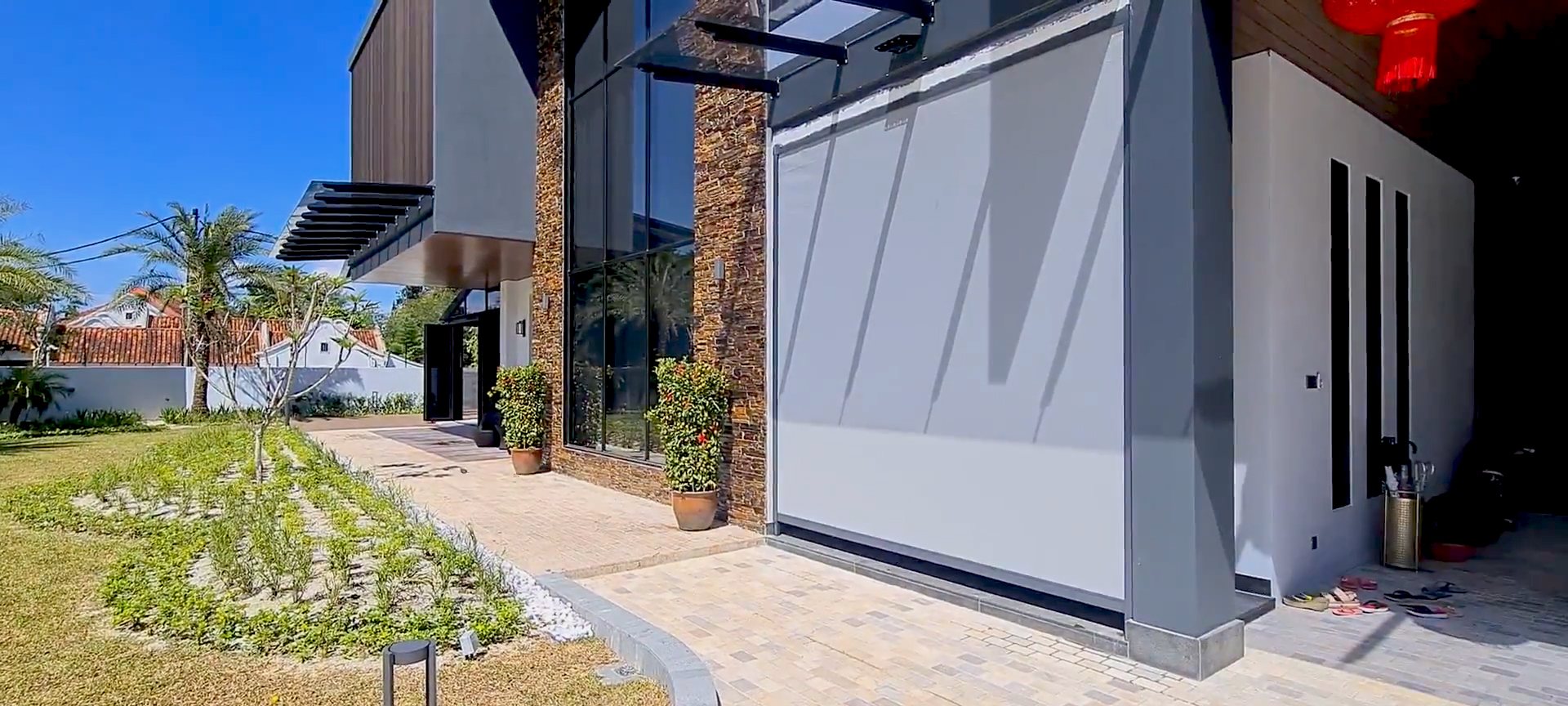
The Same Engineering. Turned Inward. Slim, Silent, Even.
For windows, partitions and sliding doors, indoors. A constant-force spring gives the same light pull at any height — in Push Pull, Hybrid or fully motorised.
What most sellers
won’t tell you.
Indoors, you are not fighting wind or driving rain. You are dealing with glare, heat through glass, and a window that looks straight onto the street. Different problems, and they want a different machine.
A chunky box above the window
Most indoor roller systems need a deep headbox. In a shallow reveal it either does not fit or it sits proud of the ceiling line and announces itself.
Slim housing
The housing is designed flat rather than padded out around a fat tube, so it tucks into a shallow reveal and reads as part of the window rather than something bolted above it.
Heavy at one end, snaps back at the other
An ordinary spring blind changes tension as the fabric unrolls. It fights you near the bottom and wants to fly up near the top. You feel it every single day.
Flat Spiral Constant-Force Spring
The spring delivers the same force whatever the drop, so the pull is identical at 0.5 metres and at 3. It is the sort of difference nobody notices in a showroom and everybody notices at home.
Something humming in a quiet room
A bedroom, a study or a meeting room hears everything. A cheap motor drones, and a loose tube rattles in the housing every time someone shuts a door.
Silent by default, motor only if you want one
Push Pull has no motor at all. Where you do want one, it is a quiet motor in a housing built to hold the tube still rather than let it drum.
The wrong system in the wrong place
The most expensive mistake in this category is putting a light-duty blind where the wind hits it full on. ZipBlind is slim precisely because it is not built for an exposed opening.
We point you to the right system
ZipBlind is for indoor openings. If yours takes the full force of the weather, we will point you to The New Expert or The New Ultra — even when ZipBlind would have been the cheaper sale.
One system.
Three ways to operate.
The fabric, the spring and the housing are the same in all three. What changes is how you drive it — and that is worth matching to how often you will actually touch the thing.
Push Pull
For the blind you use now and then.
A hand on the bar, up or down. The constant-force spring does the work, so it takes the same light effort at any height and stays exactly where you leave it. No power, no remote, nothing to charge or pair.
No wiring · lowest cost · nothing to failHybrid
For the blind you touch several times a day.
The motor for everyday use, with a manual override when you want it — or when the power is out. On a blind in daily service this is usually the one people are glad they paid for.
Motor · manual override · needs powerMotorised
For high, wide or hard-to-reach openings.
Full motor operation on a remote or a wall switch. Worth it wherever the blind is above reach, behind furniture, or wide enough that an even pull by hand is asking a lot.
Remote or wall switch · needs powerNot sure which? Tell us the room and how often the blind will move. On a window you open every morning, Hybrid usually wins. On a spare room, Push Pull is the honest answer.
The numbers
| Maximum width | Up to 4 m |
|---|---|
| Maximum height | Up to 3 m |
| Where it goes | Indoor — windows, partitions, sliding doors, offices and corridors |
| Mechanism | Flat Spiral Constant-Force Spring — even pull at any height |
| Operation | Push Pull, Hybrid, or Motorised |
| Housing | Slim, silent, no bulky headbox |
| Fabric openness | 0%, 1%, 5%, 10%, 25%, 45% |
| Colours | White, Grey, Dark Grey, Brown, Black |
| Price band | $ |
Frequently asked
What is the difference between ZipBlind and the outdoor systems?
What is a Flat Spiral Constant-Force Spring?
Can I motorise it?
How wide can it go?
Is there a bulky box at the top?
Send us the opening.
We will tell you whether ZipBlind is right for it, which of the three ways to operate suits the space — or whether you need one of the outdoor systems instead.
What happens next
- We read your measurements and photo, usually the same day.
- You get a price and a recommendation — including if a cheaper system would do the job.
- If it looks right, we arrange a site measure to confirm.
- We manufacture, then install. Most single openings take a few hours on site.
No deposit is taken at enquiry stage, and nobody will call you repeatedly. If you go quiet we assume you are still thinking.